Frost & Winter Excavation
Heated water through frozen ground, so winter repairs do not wait for spring.
Learn moreDaylighting, or utility potholing, is a hydrovac test hole that exposes a buried line so you can see its depth, size and material before a drill head or bucket goes near it. AMG Hydrovac digs test holes across Toronto and the GTA for the crews that have to work beside what is buried. Each hole is measured, photographed and handed over as a record you can design and dig from.
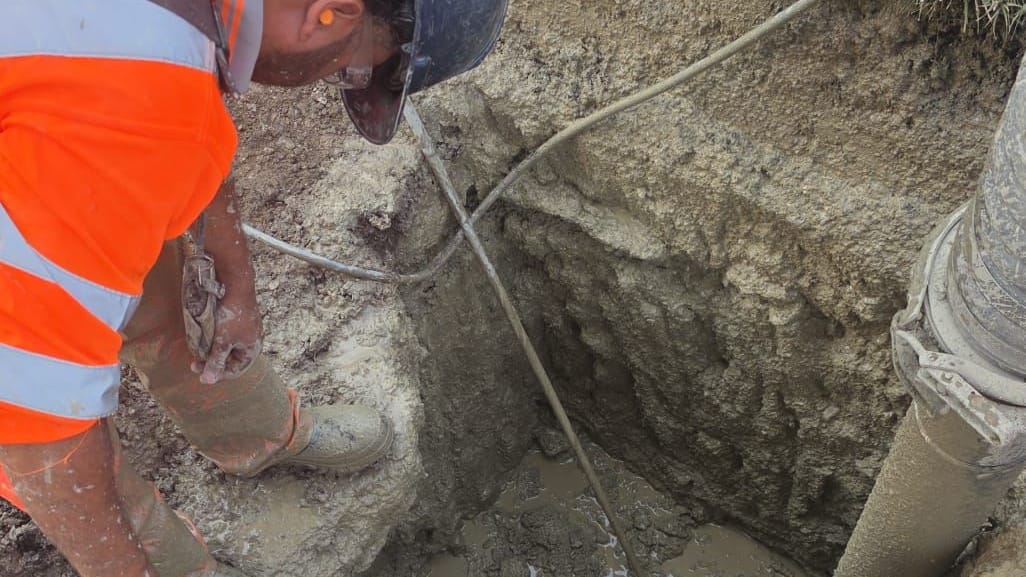 Depth check · tape on the exposed line
An Ontario One Call locate puts paint on the surface. It tells you roughly where a line runs, not how deep it sits, what it is made of, or whether it was installed where the drawing says. In older GTA neighbourhoods the as-built and the real line do not always agree.
A test hole settles it. With the ticket confirmed and any private locates in, we daylight the mark so your crew works from the exposed line, not the paint.
Pressurized water loosens the soil and the vacuum pulls the slurry into the 9 m³ (12 cu yd) debris tank. Nothing with teeth or an edge touches the ground, so the gas main, duct bank or fibre bundle is exposed intact. In frozen ground we run heated water and keep digging.
Who orders them: HDD crews proving crossings along a bore path, general contractors digging beside live services, utilities verifying their own plant before a tie-in, engineering and survey firms collecting subsurface utility data for design, and telecom builders threading conduit through a full corridor.
A downtown Toronto boulevard can carry gas, water, hydro, telecom and a duct bank within a couple of metres of each other. Hydrovac suits that ground because the hole stays the size you need and the lines you expose are not disturbed.
Remote hose reaches up to 90 m (300 ft) from the truck when it cannot park beside the dig, so the unit can sit in a lane closure while the hole goes in across the sidewalk. The boom reaches 8 m (26 ft), or 12.5 m (41 ft) extended, on a 342° turret, and a removable deflector plate drops the height under overhead lines. The operator is Book 7 trained for the live road allowance.
Everyone asks for a holes-per-day number and the honest answer is that it depends. Soil (GTA clay and compacted fill dig slower than sand), target depth, how far the truck sits from each hole, whether the holes are clustered or strung along a kilometre of road, and the distance to refill water and offload all move it. Frost adds time in winter.
Send the locate sheet or drawing with expected depths and spacing and we give you a realistic production estimate before you commit, not a number that looks good on paper.
Every hole gets a photo-and-depth record: the exposed utility with a tape in frame, depth from grade to top of pipe, size, material and offset from the locate mark or your reference point. It goes to you with the daily report, in a form your designer or surveyor can carry onto the drawing.
The spoil leaves in the tank as slurry and goes to a licensed receiving facility under our MECP EASR registration; disposal is its own line on the quote. Tell us at booking how you want the hole closed: left open and protected for your crew to tie in, or backfilled and compacted in lifts with the material you specify and left ready for surface restoration.
In practice, yes. A pothole is the test hole; daylighting is what it does, bringing the buried utility into daylight so it can be measured. Some crews say daylighting for a run of holes along an alignment and potholing for a single verification hole.
Yes. We confirm a valid ticket before the truck mobilizes, and we can arrange private locates for services the public registry does not cover, such as site lighting, irrigation or private runs between buildings.
Yes. We run heated water, so winter daylighting ahead of a bore or repair goes through the frost. Each hole takes longer than it would in summer.
As small as the target allows. A single service needs a hole just wide enough to see and measure the line; a deeper target or a duct bank needs a wider one so the walls stay stable. We size each hole to the depth and tell you the footprint before we cut pavement.
Give us the number of holes, locations and expected depths and you get a written price the same business day. It is hourly with a minimum per dispatch; mobilization and disposal are separate lines, and there is no fuel surcharge. Contractors, utilities and municipalities get account pricing on a PO or approved account.
Heated water through frozen ground, so winter repairs do not wait for spring.
Learn moreWatermain breaks, spills and struck utilities. Dispatch answered 24/7 by the owner.
Learn moreExpose, repair, replace, raise and thaw water boxes and curb stops without damaging the service.
Learn moreSend the hole count, locations and expected depths and you get a written price the same business day. Call or email to book.